
I was fifteen when my mother asked me to take photos of her, my stepdad, and my siblings.
I stood behind the camera while they posed together, close, smiling.
Later, she chose one of the pictures, framed it, and hung it on the wall. Her family.
I wasn’t in it.
There wasn’t a picture of me nearby. No space cleared. No second frame added. Just a silent reminder of who mattered.
They didn’t say I was unwanted. No one announced that I didn’t belong.
But I felt it.
Your story might be different.
It might not be a picture on a wall.
Maybe it was the empty seat at your performances or games, the way your milestones passed without much notice, or maybe your caregivers were cold to you but warm and nurturing to other people.
The details might be different, but the hurt is the same.
You were present, but not seen
There, but not valued.
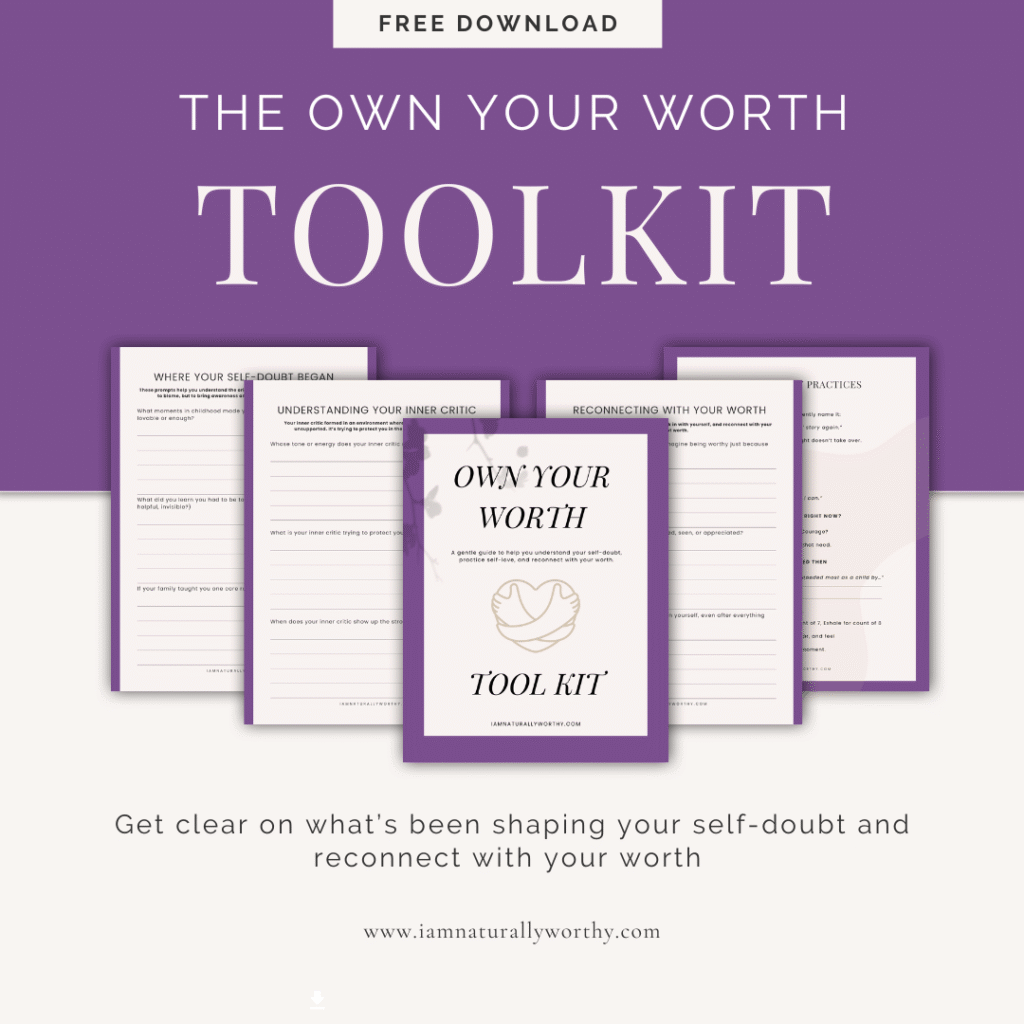
Bonus: As a bonus for joining my weekly newsletter, get a free copy of the Own Your Worth Toolkit which is designed to help you manage self-doubt so you can find your voice and confidently embrace who you are
What You Learn From That
When you grow up feeling unwanted, you adapt.
- Some children try harder. They become impressive, helpful, easy.
- Some shrink. They stay quiet and try not to need too much.
- Some detach. They tell themselves they don’t care.
The strategies may vary, but they have the same goal: to protect you from the pain of not being chosen.
So you try to prevent rejection before it happens.
Without realizing it, you start watching yourself, your tone, your reactions, your opinions, making sure nothing about you pushes love away.
You become very attuned to other people’s moods and responses.
Instead of asking, “What do I feel?”
You ask, “Are they okay with me?”
Gradually, safety gets tied to acceptance, and you start to base your worth on whether or not you’re chosen.
Here’s The Thing…
When you grow up feeling unwanted, you don’t stop adapting. You carry whatever strategy that got you through childhood into adulthood.
Maybe you learned that silence kept things calm, achievement earned praise, and being easy caused fewer problems. So you shaped yourself around these lessons.
Eventually, adapting stops feeling like a strategy, and it feels more like your personality.
You become:
- Low Maintenance
- Independent
- The Strong One
But underneath those labels, a part of you still believes your place isn’t guaranteed.
So you keep adjusting.
You keep proving.
You keep making sure there’s no reason to be rejected.
The environment may have changed. But your nervous system is still trying to protect you the only way it knows how.
Why Loving Yourself Feels So Hard
If you grew up feeling unwanted, loving yourself can feel uncomfortable, even wrong.
Somewhere along the way, “I’m not wanted” quietly turned into “I’m not good enough.”
When that belief settles in, self-love doesn’t feel natural. It feels dishonest.
How can you love something you were taught wasn’t enough?
So when you try to take up space, believe in your worth, or treat yourself with care, something in you hesitates.
Of course it does.
You’re not struggling with discipline. You’re untangling a belief that formed when you felt unwanted.
And that takes time.

Loving Yourself Isn’t About Pretending
Loving yourself isn’t rewriting your history.
It isn’t forcing affirmations that don’t feel true or minimizing your childhood.
Self-love doesn’t ask you to deny that you felt unwanted.
It asks you to acknowledge what that did to you.
It hurt.
Over time, it shaped the belief that something about you wasn’t enough.
And it stayed with you.
Loving yourself isn’t pretending you always believed in your worth.
It’s recognizing that “I’m not good enough” grew from real experiences, and choosing not to let those experiences define you.
It’s turning toward the younger you and saying:
Of course you felt that way.
You were trying to survive.
Related: How To Accept Love and Self Love When You Grew Up With Emotionally Immature Parents (Printable)
What Happens When You Learn How To Love Yourself
When you learn how to love yourself, the shift isn’t dramatic or performative. You don’t suddenly become fearless or perfectly secure.
But something inside you softens. You stop relating to yourself as a problem to fix and start relating to yourself as someone worth caring for.
You begin to notice changes like:
- You stop chasing people who make you question your value.
- You feel less threatened by shifts in someone’s mood.
- You don’t immediately assume distance means rejection.
- You trust that you belong in rooms without proving why.
- You speak more freely and take up space more naturally.
- You feel less urgency to impress, explain, or overperform.
The deepest shift is internal.
You move from:
Do I deserve to be here?
To:
I belong here.
And that quiet belief changes how you move through the world.
Related: How To Manage Your Inner Critic And Stop Doubting Yourself (Printable)
A Way Forward
You didn’t choose the environment that shaped you, and you can’t go back and make yourself feel more wanted.
But you can start noticing the ways you still move through the world as if something is wrong with you.
The moments you shrink, over-explain yourself, or work harder to make sure you’re not “too much” or “not enough.”
You can begin catching these moments, not to judge yourself, but to gently question the assumption underneath them.
Not all at once.
Not perfectly.
Just often enough that your nervous system starts to realize that you’re not fighting for your place anymore.
You’re allowed to be here without earning it.
How to Love Yourself When You Feel Unwanted
Loving yourself after growing up feeling unwanted isn’t about becoming more confident. It’s about changing how you respond to the fear that you’re not valued.
So when you notice yourself having thoughts that you’re unwanted:
1. Stay with the fear.
When someone seems distant or distracted, notice the rush that hits your body. Notice the urge to fix it, send another text, explain yourself again, or pull away before they leave you.
Don’t act on it right away.
Pause. Take one breath. Let the discomfort sit without trying to solve it. Remind yourself that distance doesn’t automatically mean rejection.
Give the feeling space to rise and fall before you decide what to do next.
2. Don’t shrink to secure connection.
When you notice the urge to soften your opinion, downplay your needs, or smooth yourself out to keep the peace, breathe. Name what’s happening instead of automatically adjusting.
Let your perspective stand, even if it feels uncomfortable. You don’t have to harden or argue. Hold your position gently and let your needs exist in the room without apologizing for them.
Remind yourself, connection doesn’t require you to disappear.
3. Stop over-functioning.
Notice when you start managing the moment–filling the silence, smoothing tension, anticipating needs before anyone names them. Notice how quickly you volunteer to carry more so no one feels uncomfortable.
Then experiment with doing less.
Allow a little silence without rushing to fill it.
Resist the urge to be the one who always reaches out.
Trust that the conversation can hold itself.
You don’t have to work that hard to keep connection alive.
4. Tell yourself the truth.
When the old “I’m unwanted” story shows up, stop and notice it as a thought. Not a fact. Not a prediction. Just a familiar sentence your mind learned to repeat.
It might feel heavy. It might sound convincing. But it’s still just a thought
You can acknowledge it without agreeing with it. You can say, “There’s that story again,” and offer yourself some compassion for how often you’ve carried it.
Then choose not to let that thought decide who you are or how you move in the moment.
5. Continue to show up as you are.
Speak honestly, even if your voice shakes. Say what you actually prefer instead of defaulting to “whatever’s fine.” Let yourself take up space without apologizing for it.
Allow people to see the real you, not the polished, edited version, just you.
None of these are dramatic shifts.
They are small, steady ways of responding differently to the old fear of not being chosen
And slowly, your nervous system learns:
You don’t have to audition for love.
You belong and deserve to take up space.
Watch Out For This
As you begin learning how to love yourself, you may notice something unexpected:
Grief.
A quiet sadness. A sudden wave of anger. A tenderness toward your younger self that catches you off guard.
When you stop blaming yourself for feeling unwanted, you start seeing more clearly what you didn’t receive. And that clarity can hurt.
You may grieve the affection that wasn’t there.
The reassurance you needed.
The version of you who worked so hard to be chosen.
This doesn’t mean you’re being a victim.
It means you’re no longer minimizing what you lived through.
If grief comes up, stay gentle. Give yourself the compassion you’ve needed all along.
Final Thoughts
When I look back at that framed photo, I no longer see proof that I wasn’t enough.
Instead, I think about young me standing behind the camera, trying to earn her place.
But she deserved to be included in the photo.
She didn’t need to earn it.
If you grew up feeling unwanted, you might still try to secure your place and work to prove that you belong instead of simply knowing you do.
But being left out once, or even many times, doesn’t prove that you’re flawed.
It was evidence of what you didn’t receive.
Loving yourself now is choosing to stop treating your existence like something that needs justification.
You don’t have to earn your place.
You already belong.
Want More?
If you’re ready to keep growing and deepening your relationship with yourself, there’s a way to keep the momentum going. The Own Your Worth Toolkit is a gentle next step.
Inside this free guide you’ll find reflection prompts to explore the origins of your self-doubt, how to reconnect with your worth, and soothing practices to help you meet yourself with compassion.
Each time you use this toolkit, you loosen the grip of shame and strengthen your connection to the truth that’s always been there–that you’re worthy, just as you are.
Download your copy of the Own Your Worth Toolkit and give yourself the space to pause, reflect, and nurture your worth, one compassionate step at a time.
Your Turn
What’s helped you learn how to love yourself in ways you weren’t taught growing up?