
Do you ever feel like no matter what you do, it’s never enough?
You accomplish something you’ve been working toward, but the satisfaction barely lasts before your mind starts picking it apart.
“It wasn’t that hard.”
“You got lucky.”
“You should’ve done this sooner.”
Instead of recognizing what went well, your attention goes straight to what you should have done differently.
That’s the inner critic.
It’s the voice that constantly pushes for more while convincing you that who you are and what you’ve done isn’t enough.
Bonus: As a bonus for joining my weekly newsletter, get a free cheat sheet of the Inner Critic Reset Plan and learn how to cope with self-critical thoughts in the moment.
But Here’s The Thing…
Being hard on yourself doesn’t create lasting confidence or motivation.
The inner critic might promise that more pressure will help you do better, avoid mistakes, and stay motivated.
But that promise is based on the idea that criticism is what drives growth.
And yes, criticism can get you moving in the short term, especially when you’re afraid of failing or getting something wrong.
The problem is that fear and self-judgment aren’t sustainable sources of motivation.
People don’t learn and grow because they’re constantly judging themselves.
They grow because they’re willing to try, make mistakes, learn from them, and keep going.
Growth requires curiosity, flexibility, and the willingness to be imperfect.
Where Did Your Inner Critic Come From?
The way you speak to yourself is often shaped by the messages you received growing up.
If you were frequently criticized, compared to others, or made to feel like what you did was never quite enough, these messages can stay with you.
Even when the people who said them are no longer around, their words might still show up when you make a mistake, try something new, or fall short of your own expectations.
As time goes on, these messages become the lens through which you see yourself.
You might start to believe that mistakes make you a failure, that you have to be perfect to be accepted, or that your worth depends on how well you perform.
Before you know it, you start attacking yourself with the same harsh criticisms that others once said to you.
And because that voice has been with you for so long, it can feel familiar and believable, even when it’s holding you back.
Related: 4 Tyles Of Emotionally Immature Parents And How To Respond To Them

What The Inner Critic Costs You
The cost of the inner critic goes beyond feeling bad about yourself.
When you constantly criticize who you are, it’s hard to trust your own judgment.
You second-guess decisions, look to others for reassurance, and spend more time worrying about getting things wrong than moving forward.
The pressure to avoid mistakes can keep you stuck.
You might procrastinate, overprepare, or wait until you feel completely confident before taking action.
And because the critic is always looking for what’s wrong, it’s difficult to feel good even when you’re successful.
The inner critic promises growth, but often takes away the very things that help you grow: confidence, self-trust, and the willingness to learn as you go.
Related: 7 Signs Of Self Abandonment (And What To Do About It)
What Happens When You Stop Accepting The Critic As Truth
Many people worry that if they stop listening to their inner critic, they’ll become lazy, complacent, or stop striving for more.
After all, the critic often presents itself as a coach, a motivator, or the voice that keeps you from making mistakes.
It tells you that if you’re not hard on yourself, you’ll stop trying.
But questioning the critic doesn’t mean lowering your standards or giving up on growth.
It means recognizing that criticism and accountability are not the same thing.
The inner critic tends to focus on shame, judgment, and everything you’re doing wrong.
Growth, on the other hand, comes from being able to acknowledge mistakes, learn from them, and keep moving forward.
You can still challenge yourself, pursue meaningful goals, and work toward becoming the person you want to be without constantly attacking yourself.
In fact, when you’re not weighed down by self-doubt, perfectionism, or fear of failure, it often becomes easier to take risks, try new things, and learn from experience.
Related: How to Accept Love and Self Love When You Have Emotionally Immature Parents (Printable)
A Different Way Forward
If you’ve spent years listening to your inner critic, it’s understandable if this voice feels convincing.
You might even believe that being hard on yourself is the reason you’ve accomplished what you have.
But the goal isn’t to silence the critic or make it disappear.
The goal is to stop giving it complete control over how you see yourself and the choices you make.
The truth is, your inner critic will probably still show up from time to time.
The difference is that you don’t have to automatically believe everything it says.
You can learn to notice the critic, make room for the thoughts it brings up, and choose how you want to respond instead.
This shift takes practice, but it can change the way you relate to yourself.
Rather than being pushed around by self-doubt and criticism, you begin to respond with more awareness, self-compassion, and trust in your ability to handle what comes next.
The Inner Critic Reset Plan can help you get started.
Related: Feeling Never Good Enough? How To Manage Self Doubt

The Inner Critic Reset Plan
Step 1: Pause
Take a slow, deep breath. Feel the air move through your body.
Notice what your mind is telling you. Maybe it’s criticizing you, warning you, or predicting the worst.
See if you can simply acknowledge the thought without arguing with it.
Some people find it helpful to say, “Thanks, mind. I see what you’re doing.”
Why this helps:
When self-critical thoughts show up, it’s easy to get pulled into them without realizing it.
Pausing helps you slow down and notice what’s happening before you react.
That brief moment of awareness can make it easier to respond in a way that reflects your values instead of your inner critic.
Step 2: Connect
Once you’ve paused and noticed what your mind is doing, the next step is to reconnect with the present moment.
When the inner critic shows up, it’s easy to get pulled into your head replaying the past, worrying about the future, or getting caught up in self-doubt.
Take a slow breath and bring your attention to something happening right now.
Maybe it’s the feeling of your feet on the floor, your breath flowing in and out of your body, or the support of the chair beneath you.
If focusing on your body feels difficult, look around and notice what you can see, hear, or feel.
Let your attention rest on what’s happening in this moment.
Why this helps:
The inner critic thrives when you’re caught up in thoughts about what happened or what might happen.
Connecting with the present moment helps you step out of those mental loops and shift your attention to what’s happening now.
The critic might still be there, but it no longer becomes the center of your attention.
Step 3: Choose
Once you’ve grounded yourself in the present, the next step is to choose how you want to respond.
Your inner critic might still be loud, offering unsolicited advice, warning you, judging you, or telling you to play it safe.
This doesn’t change the fact that you’re still in control, not your thoughts.
You don’t have to wait for your critic to quiet down before taking action. Ask yourself:
“What’s one small, kind choice I can make right now that reflects what matters to me?”
That choice might be sending the message you’ve been overthinking, taking a break when you’re tired, or speaking to yourself with compassion instead of criticism.
It doesn’t have to be big, just something that reflects your values.
Why this helps:
Your inner critic wants to keep you safe, but it often keeps you stuck.
Each time you act in line with your values, you strengthen self-trust and remind yourself that your critic doesn’t get the final say.
Before You Go…
Understanding your inner critic is one thing, but remembering what to do when you’re in the thick of it is another story.
When you’re triggered, your emotions take the driver’s seat and your critic steps in to help.
It tries to protect you in the only way it knows how… by being loud.
All the insight you have about your inner critic goes out the window.
You might hear that familiar voice again, whispering that you’re not enough or that you should’ve done better.
This isn’t a sign of failure or an indication that you haven’t made progress in coping with your critic.
Remember, your brain is wired to protect you when you feel triggered, not to keep you calm, cool, and collected.
During these spirals, it’s important to have a go-to strategy to ground yourself.
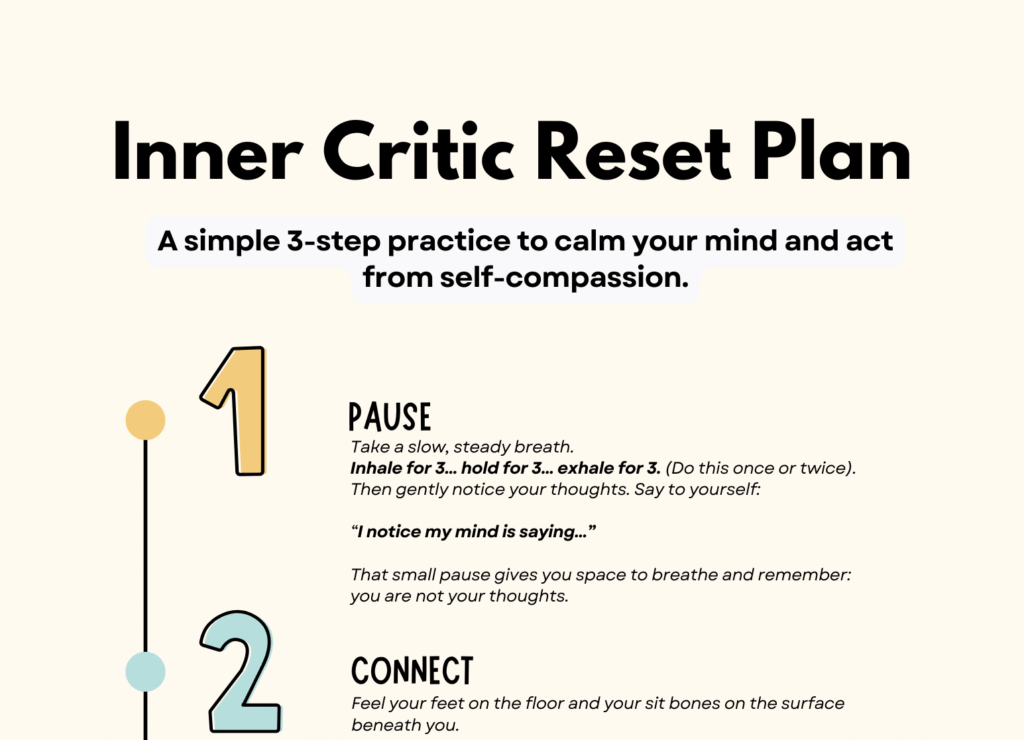
That’s why I created a visual reminder to help you navigate inner critic spirals.
The Inner Critic Reset Plan Cheat Sheet
This is a quick guide you can use whenever self-criticism takes over.
It walks you through what to do in the moment so you can pause, reconnect with yourself, and respond with more self-compassion.
When you’re caught up in self-criticism, it’s often hard to remember the tools and strategies that help.
This cheat sheet gives you something concrete to reach for so you don’t have to figure it out in the moment.
Keep the cheat sheet on your phone or print it out so it’s there when you need it.
Here’s a sneak peek of your printable cheat sheet:
Want More?
The inner critic often convinces you that your worth depends on what you achieve, how you perform, or what other people think of you.
If you’d like to continue exploring self-worth and self-compassion, this might be helpful:
Surviving Emotionally Immature Parents: How To Reclaim Your Worth
Your Turn
What are some positive strategies you use to manage your inner critic when it gets loud?