
Do you ever feel like no matter what you do, it’s never enough? You keep chasing the next thing, trying to earn that feeling of “finally, I did it.” But even when you reach your goals, your mind picks it apart:
“It wasn’t that hard.”
“You got lucky.”
“You should’ve done this sooner.”
The chatter from your mind doesn’t let up and finds fault in everything you do. It questions if you have what it takes, points out your flaws, and constantly reminds you that you’re not living up to expectations.
This is the work of your inner critic, the part of your mind that believes being hard on yourself will drive you to do better. But instead of motivating you, your critic leaves you feeling anxious, full of doubt, and stuck replaying endless ‘what ifs.‘
“What if I’m not good enough?”
“What if I mess up?”
“What if I can’t do it?”
So you push yourself harder, hoping that if you stay disciplined, do more, and achieve more, the voice will finally quiet down.
Bonus: As a bonus for joining my weekly newsletter, get a free cheat sheet of the Inner Critic Reset Plan and learn how to cope with self-critical thoughts in the moment.
But Here’s The Thing…
Pushing yourself harder doesn’t silence your inner critic, it makes it louder. Sure, at first it might feel like the pressure keeps you motivated to succeed, but underneath that drive is exhaustion. You find yourself constantly hustling for approval and grasping for a version of “enough” that’s always out of reach.
Every time you hit a milestone, your critic moves the goalpost. Your mind hones in on the one thing you could’ve done differently or compares you to someone it believes is doing a better job.
After a while, you start to feel worn down. You stop trusting yourself, doubt every decision you make, and become preoccupied with all the ways you think you’re falling short. Even simple tasks start to feel overwhelming because you’re afraid of getting it wrong.

How Your Inner Critic Keeps You Stuck
Your inner critic might seem like just a voice in your head, but it can deeply impact all areas of your life. It affects the way you see yourself, influences the choices you make, and shapes how you move through the world. When this voice is loud and harsh, it convinces you that playing small is safer than being seen, that perfection is the only way to be accepted, and that your worth depends on never making a mistake.
A relentless inner critic can:
- Drain your confidence and motivation
- Keep you stuck in self-doubt and fear
- Make you avoid opportunities because you feel “not enough”
- Cause stress, anxiety, and exhaustion
- Make it hard to enjoy your successes
The longer you let this voice run the show, the more it shapes your identity and limits what you believe is possible. It’s not that the critic wants to hurt you. On the contrary. It’s actually trying, in its own misguided way, to protect you from pain. But in doing so, it keeps you stuck in fear and wallowing in self-doubt.
Why Managing Your Inner Critic Matters
Learning how to manage your inner critic helps you take back your power so you can stop second-guessing yourself and start living from a place of confidence. When you stop letting your critical inner voice have the final say, there’s space for you to breathe, to choose differently, and to show up with more kindness toward yourself. Managing your inner critic helps you:
- Build self-trust. You start to believe in your ability to handle hard moments and learn from mistakes instead of avoiding them.
- Take meaningful action. You stop waiting to feel “ready” and move forward, one small, courageous step at a time.
- Feel calmer and more present. You spend less time battling your thoughts and more time connecting with what’s happening right now.
- Experience more joy and freedom. You give yourself permission to try, to fail, to grow, and to celebrate who you are, without the pressure to be perfect.
- Deepen self-compassion. You learn to speak to yourself with understanding, especially when things don’t go as planned.
As you learn to manage your inner critic, you realize it’s not the enemy. The critic’s job has always been to protect you from feeling shame, rejection, or failure. The real problem is believing that everything it says is the absolute truth. You can’t control what your mind says. Thoughts will always come and go.
But you can decide how much power you give them. You don’t have to get swept up in every story your inner critic tells you. You can notice the thought, take a breath, and remind yourself, “This is just my mind trying to protect me.”
Related: How to Accept Love and Self Love When You Have Emotionally Immature Parents (Printable)
Here’s A Strategy That Works
Once you understand that your inner critic isn’t the enemy, you can respond to it differently. The goal isn’t to shut it down or argue with it. It’s to recognize it for what it is, a story your mind tells when it senses danger, even if that danger isn’t real.
That’s where the Inner Critic Reset Plan comes in.
It’s a simple, three-step practice you can turn to whenever your mind starts spinning or that harsh inner voice takes over. Instead of getting caught up in the noise, you’ll learn how to:
- Pause and ground yourself in the present moment
- Reconnect with what truly matters to you
- Choose a response that reflects your values
This strategy isn’t about quick fixes or “positive thinking.” It’s about meeting your critical inner voice with awareness and compassion so it no longer controls how you see yourself or the choices you make.

The Inner Critic Reset Plan
Step 1: Pause
Take a slow, deep breath. Feel the air move through your body.
Notice what your mind is telling you. Maybe it’s warning you, criticizing you, or reminding you of all the ways you don’t measure up.
Quietly say to yourself, “Thanks, mind. I see you’re trying to help.”
Even if it doesn’t feel true yet, that one sentence reminds you that your mind isn’t the enemy. It’s just doing what minds do, trying to protect you from pain.
Why this helps:
Your inner critic’s job is to protect you. Unfortunately, it believes that using fear and judgment will get the job done. When you pause and acknowledge what your mind is saying, you no longer get swept up in its stories or dragged into every harsh thought it throws your way. This moment of awareness creates space for you to breathe, to choose, and to remember that your thoughts aren’t in charge, you are.
Step 2: Connect
Once you’ve paused and created some space between you and your thoughts, the next step is to connect with the moment. Your inner critic loves to pull you into your head, replaying what you said yesterday or worrying about what might go wrong tomorrow. Before you know it, you’re caught up in your thoughts and miles away from what’s happening in the here and now.
So take a deep breath and notice one thing that brings you back to the present. Maybe it’s the feeling of your feet on the floor or the air moving in and out of your body. If connecting with your body feels hard, shift your focus outward. Notice the light in the room, the temperature in the air, or the sounds that come and go. Let this simple awareness remind you that you’re here, right now.
As you do this exercise, your mind might start to wander or tell you you’re doing it wrong. It’s okay. Remember, that’s just what minds do. When you notice it, gently come back to your breath. Each time you return, you strengthen your ability to stay present. Instead of getting lost in your critic’s stories, you begin to feel more grounded in yourself.
Why this helps:
Your inner critic can keep you stuck in your head replaying the past, worrying about the future, and convincing you that you’re not enough. When you bring awareness to your body and the present moment, you interrupt this spiral.
You remember that you’re here, now, not trapped in the past or your mind’s “I’m Not Good Enough” stories. The more you practice coming back to the present, the less power your critic has over you. You start to feel grounded in yourself again, calmer, clearer, and more connected to what really matters.
Step 3: Choose
Once you’ve grounded yourself in the present, the next step is to choose how you want to respond.
Your inner critic might still be loud, offering unsolicited advice, warning you, judging you, or telling you to play it safe.
This doesn’t change the fact that you’re still in control, not your thoughts. You don’t have to wait for your critic to quiet down before taking action. Ask yourself:
“What’s one small, kind choice I can make right now that reflects what matters to me?”
That choice might be sending the message you’ve been overthinking, taking a break when you’re tired, or speaking to yourself with compassion instead of criticism. It doesn’t have to be big, just something that moves you towards your values and reflects the kind of person you want to be.
Choosing isn’t about forcing yourself to “stay positive” or pretending your inner critic doesn’t exist. It’s about making choices from self-compassion instead of fear. Everytime you make this shift, you remind yourself that it’s okay to feel uncertain and still move forward.
This is how confidence grows. Not from silencing your inner critic, but from proving to yourself that you can live in alignment with your values, even when your critic is loud. Whatever it is, let your next step reflect who you want to be, not what your critic demands.
Why this helps:
Your inner critic means well and wants to protect you from rejection and failure. But instead of keeping you safe, it often keeps you stuck. However, when you make choices that align with your values, even when your mind is noisy, you build self-trust. You remind yourself that your critic doesn’t get to call the shots, you do. This gives you the courage to move forward and create the life you want, despite what your critic tells you.
Before You Go…
Understanding your inner critic is one thing, but remembering what to do when you’re in the thick of it is another story. When you’re triggered, your emotions take the driver’s seat and your critic steps in to help. It tries to protect you in the only way it knows how, by being loud.
All the insight you have about your inner critic goes out the window. You might hear that familiar voice again, whispering that you’re not enough or that you should’ve done better. This isn’t a sign of failure or an indication that you haven’t made progress in coping with your critic. Remember, your brain is wired to protect you when you feel triggered, not to keep you cool, calm and collected.
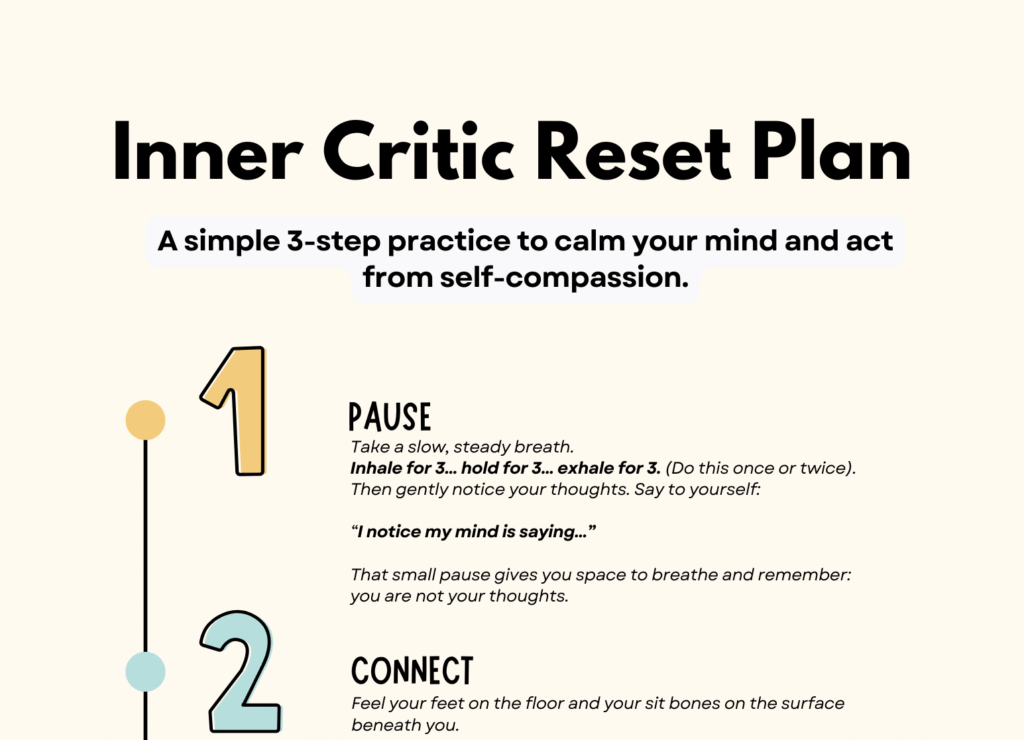
During these spirals, it’s crucial to have a gentle reminder that grounds you in the present. That’s why I created the Inner Critic Reset Cheat sheet. It’s a quick guide you can use when you feel stuck in self-criticism. It walks you through what to do in the moment so you can pause, reconnect with yourself, and take the next step from a calmer place.
You can keep the cheat sheet on your phone or print it out as a visual reminder that you don’t have to let your critic consume you. You can come back to yourself, one breath at a time. Get your Inner Critic Reset cheat sheet so the next time self-doubt shows up, you’ll have a coping plan ready!
Here’s a sneak peek of your printable cheat sheet:
Your Turn
What are some positive strategies you use to manage yourr inner critic when it gets loud? Share in a comment below.